
Stepping Out of the Noise:
The Pause is Part of the Work
A founder replies to a board email at 11pm, three minutes after it hits her inbox. Her message is fluent and quick, but slightly off. Twelve hours later, in the shower, a better answer arrives. But by then the email thread has moved on.
This is the new environment many Founders and leaders now find themselves in. Inputs arrive during the working day, and beyond, faster than they can be “metabolised”. AI has now compressed that window even further, not because the technology itself forces you to respond but because everyone else’s response time has rapidly accelerated. On the surface, this might look like productivity but the real cost is actually measured in quality of judgement or the delegation of that judgement.
The more interesting question is not do we do less. The question is what is actually being traded under that pressure, and what would it take to think more clearly?
What noise does to a leader’s brain
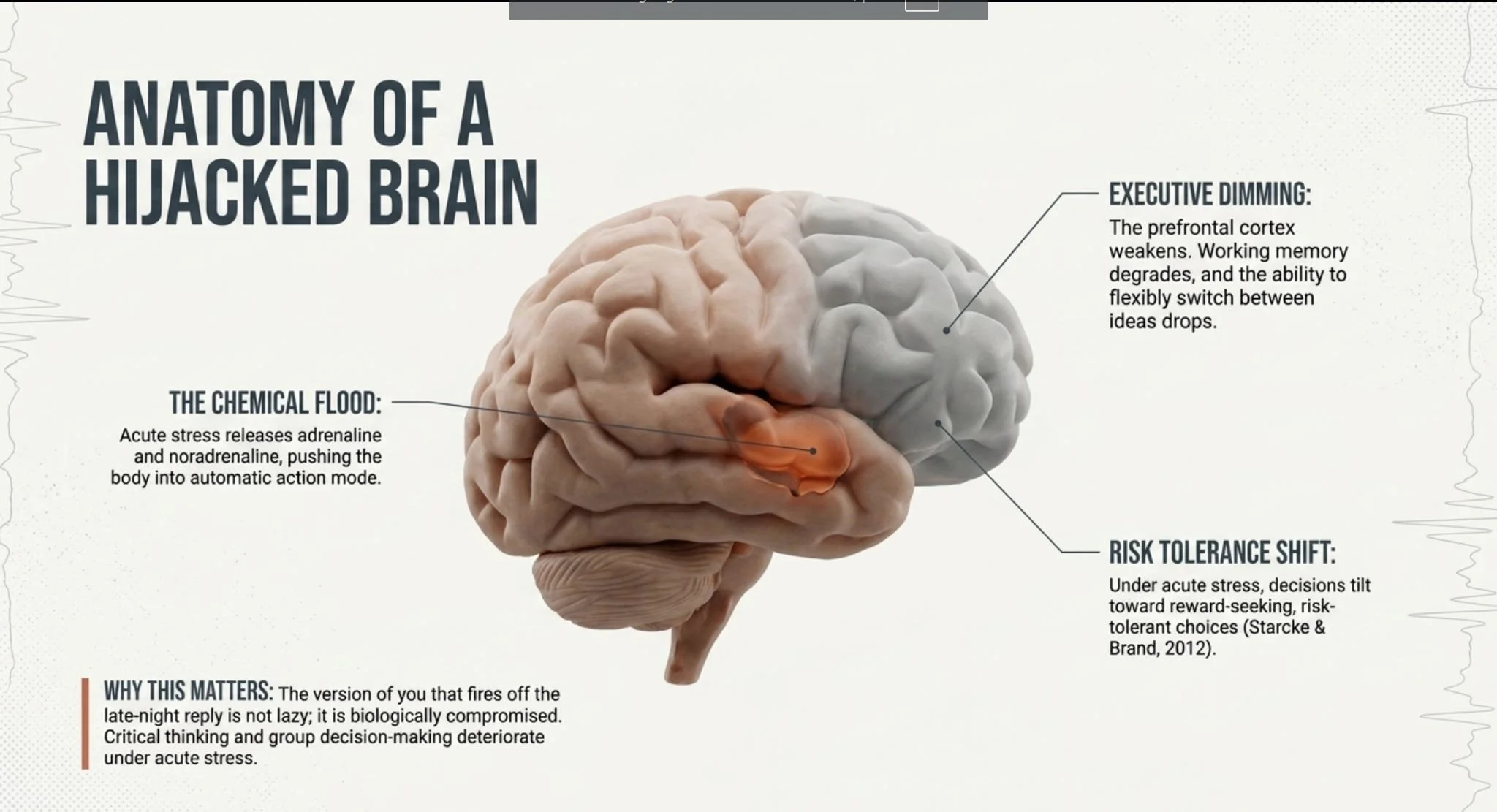
The physiology here is well described. Acute stress pushes the body into action mode through chemicals like adrenaline and noradrenaline. These weaken the part of the brain that pauses, weighs, and chooses, and strengthens the faster, more automatic systems beneath it. Working memory weakens. The ability to switch flexibly between ideas weakens. Review work on decisions under uncertainty shows that stressed people tilt toward more reward-seeking, risk-tolerant choices [1]. Your executive functions are particularly vulnerable under stress, and tend to degrade earlier and suffer disproportionately. The version of you that fires off the late-night reply is not lazy. Your biology is set up to act fast and worry about the consequences later.
Information overload is a separate problem. Reviews of this phenomenon, including “technostress” (technically defined as “stress experienced by individuals due to the use of information and communication technologies”), describe how digital systems steadily increase our mental load and strain [2].
This is closely linked in parallel with “attention residue”. This is what happens when you switch tasks before mentally closing the previous one: part of your attention stays tied up in the unfinished thread, leaving less available for the next [3]. Recent research suggests that notifications themselves disrupt thinking, independent of how much time you spend on a screen [4]. AI does not solve this. By increasing the volume and speed of inputs that demand a response, it intensifies the same scattered state, unless the day is structured to protect time to think and actually synthesise your thoughts.
Reviews of team stress compound this picture. When leaders are stressed, critical thinking, time-sensitive performance, and group decision-making are the areas of our performance that have been found to deteriorate [5].
The problem, then, is not that leaders are stressed. The problem is that they are stressed and pulled in too many directions at once, and asked to make good decisions on every one. Recovery in this context is not relaxation in the spa sense. It is the recovery of the cognitive range needed to think. Closer to an athlete’s rest day than a spa day. Rest and recovery is specifically dosed and tracked like training itself, because the adaptation happens in the gap between loads.
The hormesis correction
The physiology of adaptation is non-linear. Brief, moderate stressors can build later resilience. Chronic or excessive load harms. Recent reviews describe a just-right range of stress exposure rather than a simple “less stress is always better” rule [6]. A steady, daily dose of mid-grade stress, the kind that comes from always-on email and back-to-back calls, may be the worst pattern. It rarely peaks high enough to drive adaptation and never drops low enough to allow recovery. Conceptually similar to what some people refer to as the grey zone of athletic training: too hard for recovery or aerobic base building, but not hard enough to stimulate major cardiovascular, muscular, or threshold adaptations.
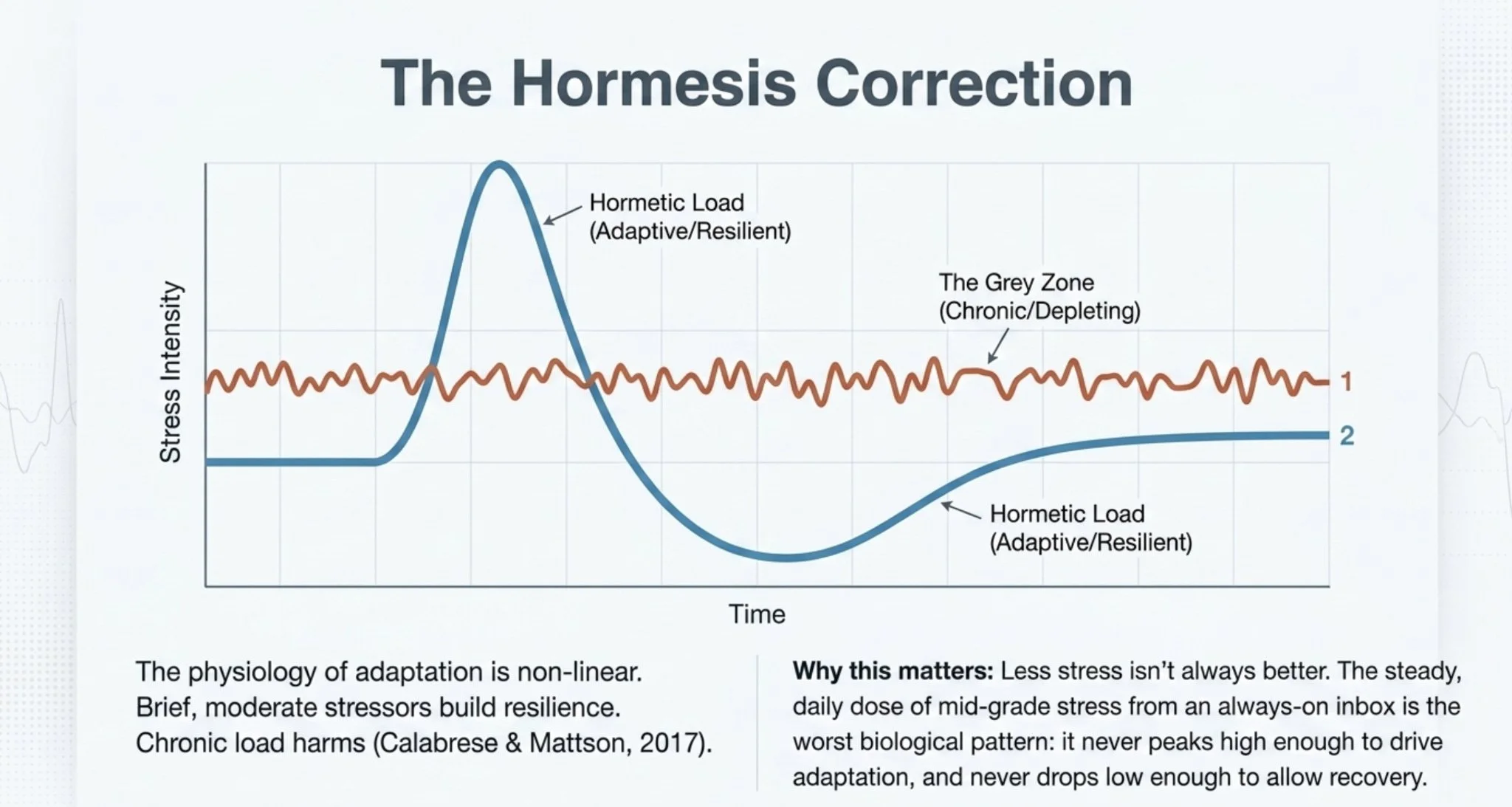
Deliberate exposure to a sharper, time-limited stressor, followed by a clear recovery window, is closer to how the system was built to be loaded. Recovery itself behaves like a performance variable. Occupational meta-analyses link recovery from work to higher wellbeing and performance and to lower demands. Psychological detachment, the ability to mentally leave work, predicts wellbeing over time [7].
That is the first half of the model. Hormesis tells you how to load the system. It does not yet tell you what the system interprets as load in the first place.
Meaning is a regulator
Alia Crum’s work fills that gap. Beginning with her 2013 paper, refined through a 2023 metacognitive intervention, she has shown that a stress-is-enhancing mindset is associated with more adaptive cortisol responses, greater feedback-seeking, and better self-reported symptoms and work performance [8].
A 2017 study found that under challenge, an enhancing mindset increased positive affect, positive attentional bias, and cognitive flexibility [9]. In a salary-negotiation experiment, higher cortisol predicted better outcomes in participants who had been told anxiety could help them, and worse outcomes in controls who had received no such instruction [10]. The chemistry was identical. The meaning differed.
The 2023 follow-up usefully highlights that this works better when the framing is balanced rather than relentlessly positive [11]. A simple “stress is enhancing” message produced an initial mindset shift in these trials, but then the effect faded as soon as people encountered evidence to the contrary, which life supplies us with daily. The version that saw a more durable response was being honest about stress being hard, but then taught people that the stance they take towards it partly determines whether it helps or harms them. People know stress is hard. Pretending otherwise produces shallow effects that fade.
The takeaway is unromantic but useful. The ambition to feel calm before every important decision is unreliable. The more durable target is to interpret activation as fuel and to act in line with what the situation actually requires. Actors and athletes use a version of this before walking out. They tell themselves the racing pulse and dry mouth are excitement, not nerves. The body does the same thing either way. The performance does not. The same relabel has been tested in the lab across singing, public speaking, and maths tasks. Telling yourself “I am excited” outperforms telling yourself “I am calm” [12]. That is not positive thinking. Reframing is an empirical regulator of cognitive flexibility, hormonal response, and behavioural follow-through.
Stepping out, honestly
This is where stepping out of noise stops being a soft idea and becomes a specific intervention. A 90-minute walk in nature has been shown to reduce rumination, the looping, self-critical thinking that runs in the background without resolving anything, and to quiet the brain regions that drive it. A one-hour nature walk reduces activity in the amygdala, the brain region that drives threat and alarm responses, compared with the same walk in a city [13].
A scoping review of 45 studies on nature and creativity found a positive overall relationship and identified the plausible mechanisms: solitude, lower sensory load, disconnection from technology, mild physical activity, and time for incubation [14].
Some of that signal we see from these papers is the getting out and moving, rather than nature. Reviews of green exercise show that outdoor settings do not reliably outperform indoor exercise [15]. The honest reading is that the benefit is composite. Slowing the input rate, lowering unnecessary arousal, moving the body, and creating space for mind-wandering all contribute. Nature makes those conditions easier to achieve, not magical.
Reflection has its own evidence base, but only the structured kind. In a dynamic business simulation, brief training in decision steps plus three self-reflective questions improved performance, adaptation to changing conditions, and planning consistency [16]. Unstructured introspection does not produce the same effect and can slide into rumination. Reflection that helps is sense-making with a question attached.
Heat and cold sit at the edge of this argument and need careful handling. Sauna produces cardiovascular and autonomic effects that resemble moderate exercise, with heart rate rising during exposure and shifting toward parasympathetic recovery during cooldown [17]. Small studies suggest post-sauna cognitive efficiency may improve, although the evidence is preliminary. In group settings, some of the benefits are likely social: ritualised pause, shared discomfort, permission to stop talking.
Cold water is more complicated than its current cultural status implies. The most recent systematic review, covering 11 studies and 3,177 participants, found increased inflammatory markers immediately and at one hour after immersion, no immediate stress benefit, and a significant reduction in stress at 12 hours [18]. Reviews of cold and cognition describe contradictory findings: cold exposure can impair working memory and executive function during the dose itself and can narrow attention onto the stressor [18].
The key message takeaway here is not that cold sharpens your strategic thinking. Cold offers a short, limited encounter with high arousal in which you can practise staying deliberate and calm under discomfort. The strategic thinking comes later, during recovery, not in the water. Open water entry below 15°C carries cold-shock physiology with breathing difficulty and blood pressure surges, and there are real cardiovascular contraindications for both heat and cold.
This is not an argument that we should all walk in forests or get into cold water. The argument is about what produces the conditions for clearer thinking. The modalities are vehicles. The mechanism is composite.
Translating it to a working week
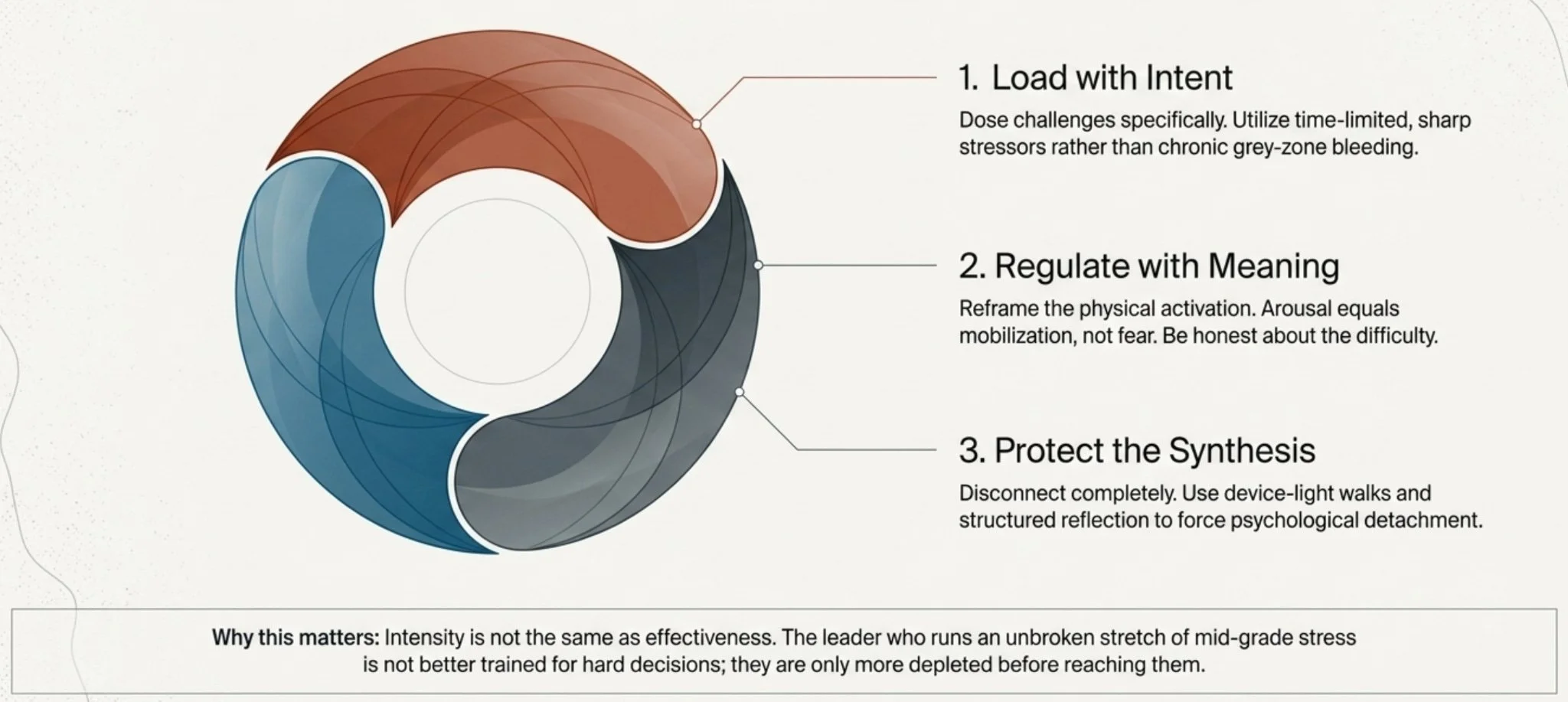
This can all be summarised by three points:
Intensity is not the same as effectiveness. The leader who runs an unbroken stretch of mid-grade stress is not better trained for hard decisions, only more depleted before reaching them. Dose challenges and pushes with intent, then recover from them on purpose.
The meaning attached to challenges or pressure matters as much as the activation itself. Reframing pressure as mobilisation is not positive thinking. The version that works under load is balanced and honest.
Protect the conditions for cognitive synthesis. A “device-light” walk, a sauna with no agenda, a sea swim followed by quiet, an evening without notifications. These are not indulgences from the work. They are part of how seasoned thinking is produced. Judgement does not arrive faster under more pressure. It arrives clearer when the system has been loaded and unloaded with care and consideration.
The leaders who outperform in the long run are unlikely to be the ones who reply quickest. They will be the ones who can hold a long pause without losing their nerve, and who treat that pause as part of the work.
Q&A
Isn’t reframing stress just positive thinking?
No. Crum’s 2023 metacognitive intervention is explicit that relentlessly positive messaging produces shallow effects that fade. The more durable message gives people balanced information about stress and lets them choose a more useful stance toward activation when a situation calls for it. The change shows in cortisol patterns, attention bias, and cognitive flexibility, not just in self-report.
Does cold water actually make you think more clearly?
Probably not in the moment, and the wider claim is weaker than its current cultural status suggests. The most recent systematic review found no immediate stress benefit, with a delayed reduction at around 12 hours. Cognitive reviews describe impaired working memory and executive function during exposure and narrowing of attention onto the stressor. The use case is more around arousal practice and recovery, not same-day cognitive gains.
How long does the recovery window need to be to count?
The literature does not specify a minimum dose, and the answer is likely individual. What the occupational research consistently shows is that psychological detachment matters more than wall-clock minutes. A 30-minute walk without a phone can produce more recovery than two hours that include checking email. The aim is to leave the work mentally, not just physically.
Further Reading
[1] K. Starcke and M. Brand, ‘Decision making under stress: a selective review’, Neurosci. Biobehav. Rev., vol. 36, no. 4, pp. 1228–1248, Apr. 2012, doi: 10.1016/j.neubiorev.2012.02.003.
[2] M. Arnold, M. Goldschmitt, and T. Rigotti, ‘Dealing with information overload: a comprehensive review’, Front. Psychol., vol. 14, p. 1122200, Jun. 2023, doi: 10.3389/fpsyg.2023.1122200.
[3] S. Leroy, ‘Why is it so hard to do my work? The challenge of attention residue when switching between work tasks’, Organ. Behav. Hum. Decis. Process., vol. 109, no. 2, pp. 168–181, Jul. 2009, doi: 10.1016/j.obhdp.2009.04.002.
[4] J. D. Upshaw, C. E. Stevens, G. Ganis, and D. L. Zabelina, ‘The hidden cost of a smartphone: The effects of smartphone notifications on cognitive control from a behavioral and electrophysiological perspective’, PloS One, vol. 17, no. 11, p. e0277220, 2022, doi: 10.1371/journal.pone.0277220.
[5] D. Sorensen, S. Cristancho, M. Soh, and L. Varpio, ‘Team Stress and Its Impact on Interprofessional Teams: A Narrative Review’, Teach. Learn. Med., vol. 36, no. 2, pp. 163–173, 2024, doi: 10.1080/10401334.2022.2163400.
[6] ‘How does hormesis impact biology, toxicology, and medicine? | npj Aging’. Accessed: May 20, 2026. [Online]. Available: https://www.nature.com/articles/s41514-017-0013-z
[7] ‘Leaving Work at Work: A Meta-Analysis on Employee Recovery From Work - Laurens Bujold Steed, Brian W. Swider, Sejin Keem, Joseph T. Liu, 2021’. Accessed: May 20, 2026. [Online]. Available: https://journals.sagepub.com/doi/abs/10.1177/0149206319864153
[8] A. J. Crum, P. Salovey, and S. Achor, ‘Rethinking stress: The role of mindsets in determining the stress response’, J. Pers. Soc. Psychol., vol. 104, no. 4, pp. 716–733, 2013, doi: 10.1037/a0031201.
[9] ‘The role of stress mindset in shaping cognitive, emotional, and physiological responses to challenging and threatening stress: Anxiety, Stress, & Coping: Vol 30 , No 4 - Get Access’. Accessed: May 20, 2026. [Online]. Available: https://www.tandfonline.com/doi/full/10.1080/10615806.2016.1275585
[10] ‘Adaptive Appraisals of Anxiety Moderate the Association between Cortisol Reactivity and Performance in Salary Negotiations | PLOS One’. Accessed: May 20, 2026. [Online]. Available: https://journals.plos.org/plosone/article?id=10.1371/journal.pone.0167977
[11] A. J. Crum et al., ‘Evaluation of the “rethink stress” mindset intervention: A metacognitive approach to changing mindsets’, J. Exp. Psychol. Gen., vol. 152, no. 9, pp. 2603–2622, 2023, doi: 10.1037/xge0001396.
[12] A. W. Brooks, ‘Get excited: Reappraising pre-performance anxiety as excitement’, J. Exp. Psychol. Gen., vol. 143, no. 3, pp. 1144–1158, 2014, doi: 10.1037/a0035325.
[13] S. Sudimac, V. Sale, and S. Kühn, ‘How nature nurtures: Amygdala activity decreases as the result of a one-hour walk in nature’, Mol. Psychiatry, vol. 27, no. 11, pp. 4446–4452, Nov. 2022, doi: 10.1038/s41380-022-01720-6.
[14] D. A. Vella-Brodrick, K. J. Lewis, and K. Gilowska, ‘Exploring the Nature-Creativity Connection Across Different Settings: A Scoping Review’, Educ. Psychol. Rev., vol. 36, no. 4, p. 134, Nov. 2024, doi: 10.1007/s10648-024-09964-0.
[15] ‘The Effects of Green Exercise on Physical and Mental Wellbeing: A Systematic Review - PMC’. Accessed: May 20, 2026. [Online]. Available: https://pmc.ncbi.nlm.nih.gov/articles/PMC6518264/
[16] S. J. Donovan, C. D. Güss, and D. Naslund, ‘Improving dynamic decision making through training and self-reflection’, Judgm. Decis. Mak., vol. 10, no. 4, pp. 284–295, Jul. 2015, doi: 10.1017/S1930297500005118.
[17] ‘Cardiovascular and Other Health Benefits of Sauna Bathing: A Review of the Evidence - PubMed’. Accessed: May 20, 2026. [Online]. Available: https://pubmed.ncbi.nlm.nih.gov/30077204/
[18] ‘Effects of cold-water immersion on health and wellbeing: A systematic review and meta-analysis | PLOS One’. Accessed: May 20, 2026. [Online]. Available: https://journals.plos.org/plosone/article?id=10.1371/journal.pone.0317615
