
Morning or afternoon exercise: is one better for cardiometabolic health?
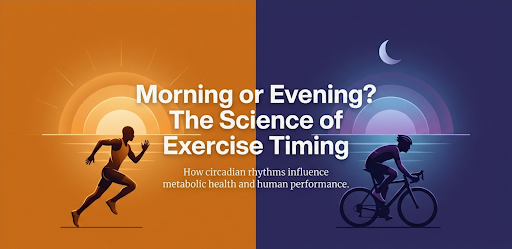
As both a clinician and someone looking to practise what I preach, I often get asked and consider what time of day might be best for exercise. Usually, the answer is that it is when you can most reliably fit it into your schedule. So let’s be clear from the start. Consistency will always trump time of day decisions.
Let’s look a little closer. If you have suboptimal metabolic health (insulin resistance, pre-diabetes etc) and are using exercise to improve your health and fitness, is it better to do this in the morning or afternoon? Before jumping to conclusions, it helps to understand why the question even comes up.
Why timing might matter
Emerging research suggests that timing has a biological context. Our bodies follow a twenty‑four‑hour rhythm, and these circadian cycles are now implicated in the development and progression of metabolic diseases.
The biology: muscle clocks and metabolic flexibility
A recent review explored how daily rhythms and exercise interact [1]. It argues that disrupted timing of activity, nutrition and sleep may exacerbate insulin resistance and obesity. In particular, skeletal muscle mitochondria appear more active in the late afternoon, and that clock function may be blunted in the muscles of people with metabolic disease.
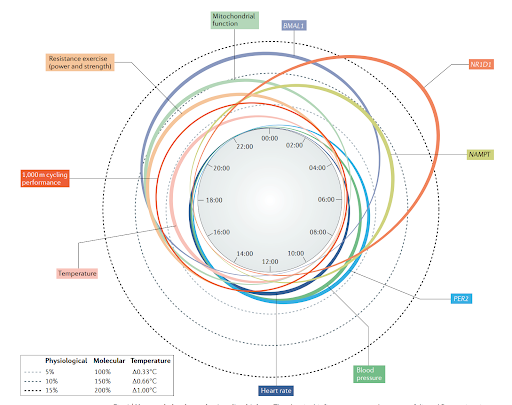
Fig: Human muscle circadian biology. Source: [1]
The review raises a practical question: could aligning exercise sessions with our biological clocks enhance metabolic benefits? That possibility has a plausible biological basis. Muscles are not just motors; they harbour their own clocks.
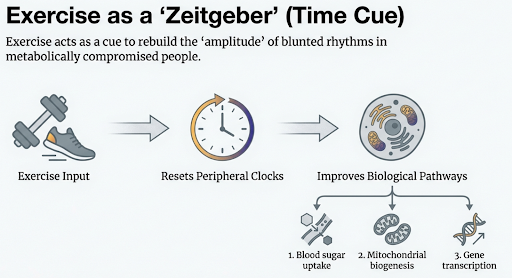
When these clocks fall out of sync with the master clock in the brain, gene expression and energy management suffer. A recent paper draws together animal experiments, human trials and lab studies to explain how exercise can reset these peripheral clocks [2]. It describes the pathways which together influence blood sugar uptake, creation of new mitochondria (mitochondrial biogenesis) and gene transcription.
In health, those pathways oscillate across the day, optimising fuel use and repair processes. In metabolic disease, however, the amplitude of those rhythms is blunted. Appropriately timed exercise may provide a “zeitgeber” signal (natural phenomenon which acts as a cue in the regulation of the body's circadian rhythms) to rebuild that amplitude, but much of this evidence comes from animal models, not people. We should therefore treat it as plausibility rather than prescription.
What controlled trials show so far
So what happens when we do this research in humans and researchers randomise people to different training times? A twelve‑week trial assigned fifty‑eight sedentary men to morning or evening aerobic sessions, or to no exercise at all [3]. All participants exercised at moderate intensity for at least one hundred and fifty minutes each week.
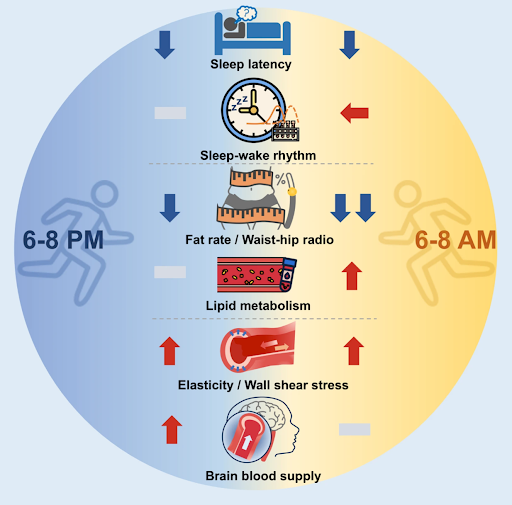
Fig: Benefits of a morning or evening 12-week aerobic exercise programme on sleep and cardiometabolic health. Source: [3].
Both morning and evening sessions reduced body fat, an effect that appeared as early as week four in the morning group. Morning exercise also lowered cholesterol and triglycerides and advanced participants’ sleep phases.
Evening exercise had a different signature: larger improvements in blood pressure and vascular function, with greater blood flow and reduced arterial stiffness. These findings suggest that the timing of exercise may modulate specific cardiometabolic outcomes; however, the study was limited to middle‑aged men, used moderate aerobic exercise, and cannot speak to long‑term disease outcomes.
Another small trial tested high‑intensity training after five days of a high‑fat diet in overweight and obese men [4]. Participants exercising in the evening displayed better glucose control and partly reversed diet‑induced changes in their metabolic profiles, whereas morning training did not shift nocturnal glucose levels. Again, the sample size was small and participants were on a short intervention, so the result invites confirmation rather than a definitive answer.
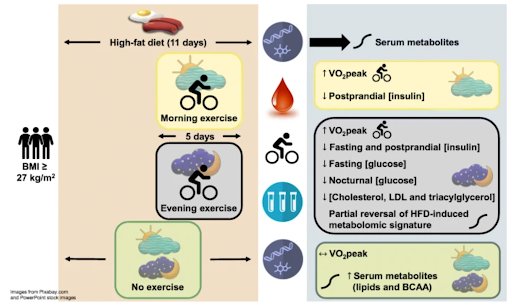
Fig: Morning versus evening cycling on metabolic markers in overweight and obese men. Source: [4]
Newer data in metabolic syndrome: morning vs afternoon HIIT
A more recent randomised trial adds weight to the conversation [5]. Investigators recruited 139 adults with metabolic syndrome, 35 % of whom were postmenopausal women, and randomised them to supervised high‑intensity interval sessions in the morning, the afternoon or a non‑training control group for sixteen weeks.
Both exercise groups improved body composition, waist circumference and cardiorespiratory fitness compared with controls, losing about 0.7 % body fat and 2 cm off the waist. However, morning training produced greater reductions in cardiometabolic markers: systolic blood pressure fell by about 4 % versus 1 % in the afternoon group, fasting insulin dropped by 12 % versus 5 %, and insulin resistance (HOMA‑IR) declined by 14 % versus 4 %. The compound metabolic syndrome “Z” score decreased by roughly half in the morning group and by about a fifth in the afternoon group. These differences may be partly explained by meal timing and composition: the afternoon group exercised after a larger meal, which may blunt fat utilisation and postmeal insulin response. Still, this trial suggests that morning high‑intensity training may offer additional benefits for blood pressure and insulin sensitivity in people with metabolic syndrome.
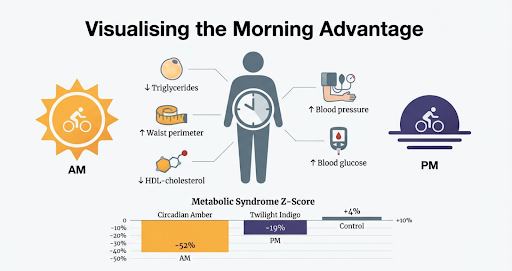
Fig: Morning versus afternoon HIIT. Data source: [5]
What population data adds, and what it cannot
Observational data provide a broader lens. Researchers from the German National Cohort analysed accelerometry from over sixty‑one thousand adults and categorised physical activity by time of day [6]. Afternoon and evening activity were associated with lower odds of obesity and diabetes compared with morning activity, whereas people who were most active at night had higher odds of these conditions. These associations persisted after adjusting for shift work, sleep duration and other factors. As with all cross‑sectional studies, causality cannot be inferred: active people may simply choose to exercise when they feel best, and their timing may reflect unmeasured behaviours such as diet composition or chronotype. Nonetheless, the pattern aligns with the experimental findings that later‑day exercise engages metabolic pathways differently from dawn sessions.
Circadian disruption as a metabolic stressor
Timing mistakes can also harm. An experiment that simulated four consecutive night shifts in healthy adults revealed how quickly circadian misalignment disrupts metabolism [7]. After just four nights, fasting glucose rose and insulin sensitivity fell by about a quarter, even though melatonin rhythms remained stable. These data imply that the body’s peripheral clocks, rather than the master clock, are vulnerable to abrupt schedule changes. Thus, appropriately timed exercise might help shift workers by providing a strong peripheral time cue.
Practical interpretation for this evolving science
Establish an exercise routine before worrying about timing.
Consistency and adequate volume remain the foundation of metabolic health.
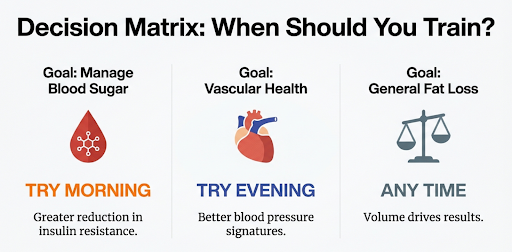
Consider that afternoon or early evening sessions may provide added benefits for vascular function and glucose control, but recognise that the evidence comes from small or moderate‑sized studies in specific populations.
Pay attention to personal responses.
Some people may feel more energetic in the morning, and forcing an afternoon workout could decrease adherence.
Remember that diet quality, sleep and stress management are at least as important as when you train.
What we still need to know
The emerging field of chrono‑exercise is promising but nascent. No study to date proves that moving your workout from dawn to dusk will prevent diabetes or reduce cardiovascular events. The most likely misinterpretation of this evidence is that there is a single “best” time of day to exercise; that notion is not supported. Instead, the current data suggest that time of day may tweak the metabolic and vascular effects of exercise, and that those tweaks may be more pronounced in metabolically compromised individuals. To move from speculation to guidance, future research must enrol women, older adults and shift workers, standardise diet and sleep, and follow participants long enough to detect meaningful health outcomes. Until then, choose a time you can maintain, listen to your body’s rhythms, and celebrate that moving at any hour is still a powerful tool for metabolic health.
Q&A
Q: Does morning exercise really improve metabolic health more than afternoon exercise?A: Evidence is mixed and population‑specific. In a sixteen‑week trial of adults with metabolic syndrome, both morning and afternoon high‑intensity interval sessions improved body composition and fitness, but morning training reduced systolic blood pressure and insulin resistance more. In contrast, a twelve‑week study in sedentary men found that evening exercise offered greater vascular benefits. These differences are modest and may be influenced by factors like meal timing.
Q: If I can only exercise at night, am I doing harm?A: Not at all. Any regular physical activity is beneficial. A large observational study found that people most active at night had higher odds of obesity and diabetes, but such data do not establish causality. Night training might reflect shift work or sleep disruption, which themselves affect health. When late‑night sessions are the only option, pairing them with consistent sleep and diet habits matters more than the clock.
Q: How strong is the evidence that exercise timing affects health outcomes?A: The field is young. Most trials are small and focus on men. They suggest that timing can tweak specific markers - such as insulin sensitivity or vascular function - rather than overturning the fundamental benefits of exercise. The largest study to date enrolled 139 adults with metabolic syndrome and found morning sessions slightly more effective for blood pressure and insulin resistance. However, long‑term outcomes like diabetes incidence or cardiovascular events have not been tested.
Q: Should I change my workout time if I have metabolic syndrome?A: Before changing anything, discuss it with your healthcare provider. High‑intensity morning training may modestly improve insulin resistance, but adherence and safety come first. If you struggle to exercise consistently in the morning, shifting to afternoons or evenings is more sustainable than skipping sessions. The evidence does not justify rigid prescriptions for everyone.
Q: What’s next for research on exercise timing?A: We need studies that include women, older adults and diverse ethnicities, test different exercise intensities and durations, and follow participants long enough to detect real clinical outcomes. Trials also need to control for diet and sleep, as these factors interact with circadian rhythms. Until then, the best advice remains to find a time you can stick with and focus on regular movement.
Further Reading
[1] B. M. Gabriel and J. R. Zierath, ‘Circadian rhythms and exercise - re-setting the clock in metabolic disease’, Nat. Rev. Endocrinol., vol. 15, no. 4, pp. 197–206, Apr. 2019, doi: 10.1038/s41574-018-0150-x.
[2] S. J. Hesketh, ‘Resetting Time: The Role of Exercise Timing in Circadian Reprogramming for Metabolic Health’, Obesities, vol. 5, no. 3, Aug. 2025, doi: 10.3390/obesities5030059.
[3] B. Shen, H. Zheng, H. Liu, L. Chen, and G. Yang, ‘Differential benefits of 12-week morning vs. evening aerobic exercise on sleep and cardiometabolic health: a randomized controlled trial’, Sci. Rep., vol. 15, no. 1, p. 18298, May 2025, doi: 10.1038/s41598-025-02659-8.
[4] T. Moholdt, E. B. Parr, B. L. Devlin, J. Debik, G. Giskeødegård, and J. A. Hawley, ‘The effect of morning vs evening exercise training on glycaemic control and serum metabolites in overweight/obese men: a randomised trial’, Diabetologia, vol. 64, no. 9, pp. 2061–2076, 2021, doi: 10.1007/s00125-021-05477-5.
[5] F. Morales‐Palomo, A. Moreno‐Cabañas, L. Alvarez‐Jimenez, D. Mora‐Gonzalez, J. F. Ortega, and R. Mora‐Rodriguez, ‘Efficacy of morning versus afternoon aerobic exercise training on reducing metabolic syndrome components: A randomized controlled trial’, J. Physiol., vol. 602, no. 23, pp. 6463–6477, Dec. 2024, doi: 10.1113/JP285366.
[6] M. J. Stein et al., ‘Diurnal timing of physical activity in relation to obesity and diabetes in the German National Cohort (NAKO)’, Int. J. Obes., vol. 49, no. 5, pp. 921–930, May 2025, doi: 10.1038/s41366-025-01721-9.
[7] R. Bescos et al., ‘Four days of simulated shift work reduces insulin sensitivity in humans’, Acta Physiol., vol. 223, no. 2, p. e13039, Jun. 2018, doi: 10.1111/apha.13039.
