Scanned, Not Screened: What the Midjourney Medical scanner actually means for your health
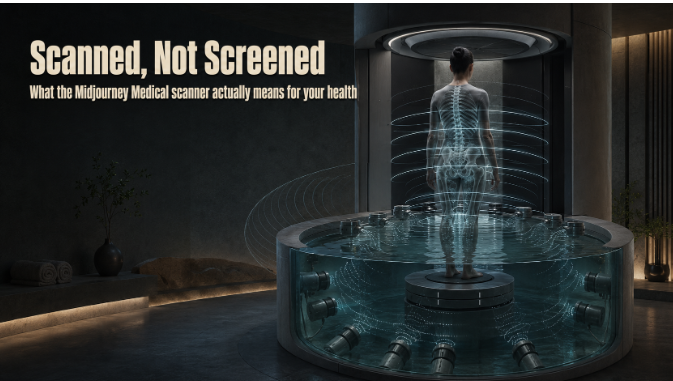
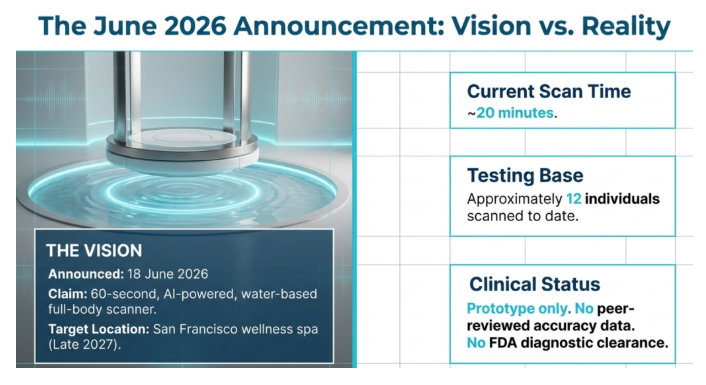
On 18 June 2026, Midjourney, the AI company best known for generating images from text prompts, announced it is building a full-body medical scanner. It uses sound waves and water, takes a target of sixty seconds, and will be housed in a wellness spa opening in San Francisco in late 2027. The announcement landed in a news cycle that moves fast, and the questions it raises deserve a careful answer rather than a quick one.
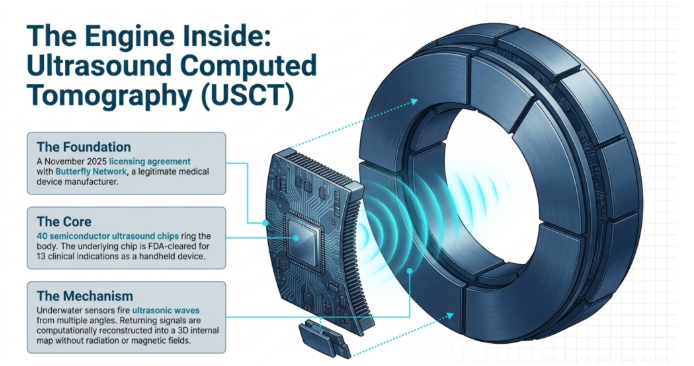
The device, called the Midjourney Scanner, is a form of Ultrasound Computed Tomography (USCT). The user descends on a motorised platform into a shallow pool, passing through a ring of underwater sensors. Those sensors fire ultrasonic waves through the body from multiple angles. The returning signals are reconstructed computationally into a three-dimensional image of the body’s interior. No radiation, no magnetic fields. The technical foundation is a licensing agreement signed in November 2025 with Butterfly Network, a legitimate medical device company whose semiconductor ultrasound chip is FDA-cleared for thirteen clinical indications as a handheld point-of-care device. Forty of these chips sit at the core of each scanner.
A prototype exists and has been publicly demonstrated. Approximately twelve people have been scanned. Current scan times are around twenty minutes, not sixty seconds, because the reconstruction algorithms required to process the data volume are still under development. No peer-reviewed clinical accuracy data exists. No FDA clearance for diagnostic use has been obtained. The device is being positioned initially as a body composition mapping tool, which places it under the FDA’s general wellness policy and means it cannot legally claim to detect, diagnose, or rule out any disease.
Where the physics gets hard
USCT is a genuine and active research field. A 2025 peer-reviewed scoping review covering 8,256 articles found meaningful advances in reconstruction methods, particularly through deep learning algorithms, while concluding that the field remains “still in its infancy, with challenges in clinical adoption, particularly in standardisation and validating performance” [1]. The most comprehensive recent synthesis of advances in USCT hardware and reconstruction methods exists, at the time of writing, only as a preprint awaiting peer review, which is itself a reasonable indicator of where the field sits on the maturity curve. The anatomical regions with the most evidence are the breast, brain vasculature, and musculoskeletal structures. Not the whole body.
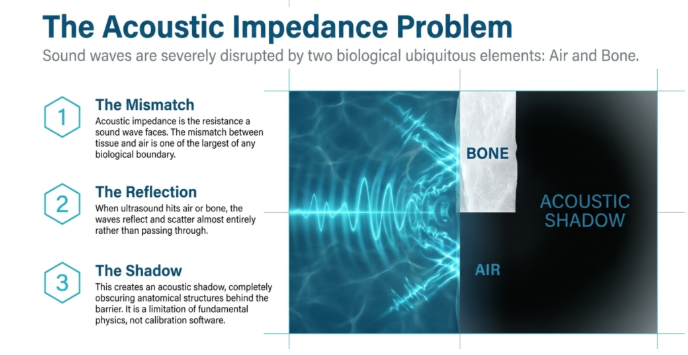
This matters because sound waves are severely disrupted by two things that are ubiquitous in the human body: air and bone. The lungs are filled with air. The bowel contains gas. Air reflects ultrasound waves almost entirely, creating acoustic shadows that obscure whatever lies behind them. This is not a calibration or software problem. It is a consequence of the acoustic impedance mismatch between air and tissue, one of the largest of any biological boundary. Bone presents a parallel barrier: the skull, ribs, vertebrae, and pelvis all reflect and scatter sound with high efficiency, shielding the very structures, brain, thoracic organs, pelvic organs, most relevant to any whole-body screen.
A recently published feasibility study of a related whole-body ultrasound system, Computed Echo Tomography, reported that its device could image through bone and gas in six normal volunteers [2]. That this constitutes a noteworthy finding illustrates where the field currently sits. Midjourney’s published materials do not address how these barriers are resolved in their system. Their own announcement describes the conversion of raw wave data into images as “a major computational task” still to be solved.
What not a diagnostic tool actually means
The regulatory framing here matters and is easy to misread. By launching as a body composition tool, Midjourney occupies the same regulatory lane as several existing whole-body MRI services operating under the FDA’s general wellness policy. This is a legitimate lane, but it is not the same as medical device clearance. Each new diagnostic capability, cancer detection, organ pathology, specific disease identification, requires separate FDA clearance. The company states it has begun discussions with the FDA. Discussions are not clearance.
The practical consequence is this: a body composition map, however detailed, is not a cancer screen. It is not a cardiovascular risk assessment. It is not a diagnostic study. A person who uses this tool believing they are being screened for disease is not being screened. They are receiving a structural map of uncertain accuracy, with no established false positive rate, no established false negative rate, and no validated reporting protocol.
If the question is body composition, DEXA already answers it
If the device’s initial and legally permissible use case is body composition, muscle mass, fat distribution, bone density, organ volumes, the relevant comparison is not MRI. It is DEXA. Dual-energy X-ray absorptiometry has decades of validation data, established reference ranges by age, sex, and ethnicity, known reproducibility, and clinical guidelines built around its outputs. It is widely available and the radiation dose is negligible, a whole-body DEXA delivers less than 10 microsieverts, equivalent to approximately one day of normal background radiation [3]. For the Midjourney scanner to displace or meaningfully complement DEXA in this role, it would need to demonstrate equivalent or superior accuracy, reproducibility across repeat scans, and validated reference ranges. None of these data exist yet. That is not a dismissal. It is the empirical question that validation studies would need to answer.
There is a more specific problem with bone density. Sound waves cannot penetrate through cortical bone to characterise internal bone mineral density at the spine or hip, the two sites that define clinical osteoporosis assessment and fracture risk stratification. This is not unique to the Midjourney system. Existing quantitative ultrasound (QUS) devices, the most developed ultrasound-based bone assessment technology available, are limited by the same physics. The International Society for Clinical Densitometry is explicit: the only validated skeletal site for clinical QUS use in osteoporosis management is the heel [4]. Even heel QUS correlates only moderately with spine and hip DEXA measurements, and the WHO diagnostic T-score criteria for osteoporosis cannot be applied to QUS results at all. They are valid only for DEXA at the femoral neck, total hip, lumbar spine, or distal radius. Whatever the Midjourney scanner can eventually offer in body composition, bone mineral density assessment at the sites that matter clinically is not within its physical reach.
A word on whole-body imaging done properly
It would be a mistake to read scepticism about this device as scepticism about whole-body imaging. Protocol-driven, specialist-reported whole-body MRI, conducted in the appropriate clinical context and interpreted by radiologists who helped design the acquisition protocol, has genuine clinical value in cancer detection. Early detection improves outcomes across multiple cancer types. That argument is not in dispute here.
What makes whole-body MRI clinically meaningful is not the machine alone. It is the acquisition protocol optimised for the clinical question, double-reporting by specialist radiologists, and a clinical framework for managing what is found. A 2019 systematic review reported false positive rates of approximately 16% in whole-body MRI of unselected asymptomatic adults [5]. That figure looks very different in a purposefully selected population scanned under a purpose-built protocol and reported by a specialist team. The number only makes sense in context. Uncontextualised scanning, however fast, however cheap, however radiation-free, does not.
What would change our view
The Midjourney programme is worth following. The underlying science is real, the engineering ambition is serious, and the goal of making high-quality body imaging more accessible is one worth pursuing. Our clinical position will update when the evidence does. The specific milestones we are watching for: peer-reviewed accuracy data with appropriate reference standards; independent validation of image quality and reproducibility; a defined FDA regulatory pathway for at least one diagnostic indication; and evidence that the lung and bowel gas imaging barriers have been addressed in a clinically meaningful way.
Until then, the scanner is a Grade D evidence technology, mechanistic and prototype only. It is not a replacement for validated whole-body MRI, not a cancer screen, and not currently a clinical tool of any kind. The more useful question, for anyone considering any imaging technology, is not whether it is new or impressive or radiation-free. It is: what has it actually earned the right to claim, and who is accountable for interpreting what it finds?
Q&A
Is the Midjourney scanner the same kind of thing as a Prenuvo or Ezra scan?
No. Prenuvo and Ezra offer whole-body MRI, a technology with an established clinical evidence base and, in reputable programmes, specialist radiologist reporting under validated protocols. The Midjourney scanner uses a different physical principle, ultrasound rather than magnetic resonance, and has no clinical validation data at this stage. They occupy the same general wellness regulatory lane, but they are not equivalent products.
Could this replace MRI in the future?
Possibly, for some applications. USCT has demonstrated genuine clinical utility in breast imaging and is an active area of research. Whether it can be extended to whole-body diagnostic imaging depends on solving the air and bone barrier problems described above, generating independent accuracy data, and obtaining diagnostic regulatory clearance. That is a plausible long-term trajectory. It is not where the technology is today.
If it’s only body composition, is it still worth doing?
It depends on what question you are trying to answer. DEXA already provides validated body composition data, lean mass, fat mass, bone mineral density, visceral fat, with decades of reference data behind it. The Midjourney scanner may eventually offer additional structural detail, but it would need to demonstrate it does so with equivalent accuracy and reproducibility before it adds clinical value over what already exists. That validation work has not been done.
References:
[1] D. de Wilde et al., ‘Ultrasound-Based Tomographic Imaging Reconstruction and Synthesis Methods: a Scoping Review’, J. Imaging Inform. Med., Oct. 2025, doi: 10.1007/s10278-025-01674-5. PMID: 41085928.
[2] J. Cheronis et al., ‘Development of Computed Echo Tomography, An Imaging Breakthrough Addressing the Limitations of Conventional Ultrasound: A Baseline Imaging Analysis for Traumatic Injuries’, JACEP Open, 2025. PMC: PMC12151677. PMID: 40496770.
[3] J. A. Shepherd, B. K. Ng, M. J. Sommer, and S. B. Heymsfield, ‘Body composition by DXA’, Bone, vol. 104, pp. 101–105, Nov. 2017, doi: 10.1016/j.bone.2017.06.010. PMID: 28625918. PMCID: PMC5659281.
[4] M.-A. Krieg, R. Barkmann, S. Gonnelli, A. Stewart, D. C. Bauer, L. Del Rio Barquero, et al., ‘Quantitative ultrasound in the management of osteoporosis: the 2007 ISCD Official Positions’, J. Clin. Densitom., vol. 11, no. 1, pp. 163–187, 2008, doi: 10.1016/j.jocd.2007.12.011. PMID: 18442758
[5] R. M. Kwee and T. C. Kwee, ‘Whole-body MRI for preventive health screening: A systematic review of the literature’, J. Magn. Reson. Imaging, vol. 50, no. 5, pp. 1489–1503, 2019, doi: 10.1002/jmri.26736. PMID: 30932247.
[6] Midjourney Medical. Company announcement. Midjourney.com/medical. 18 June 2026.
By Dr Andrew Crockett