
Enhanced Games. Eviscerated Stock Price.
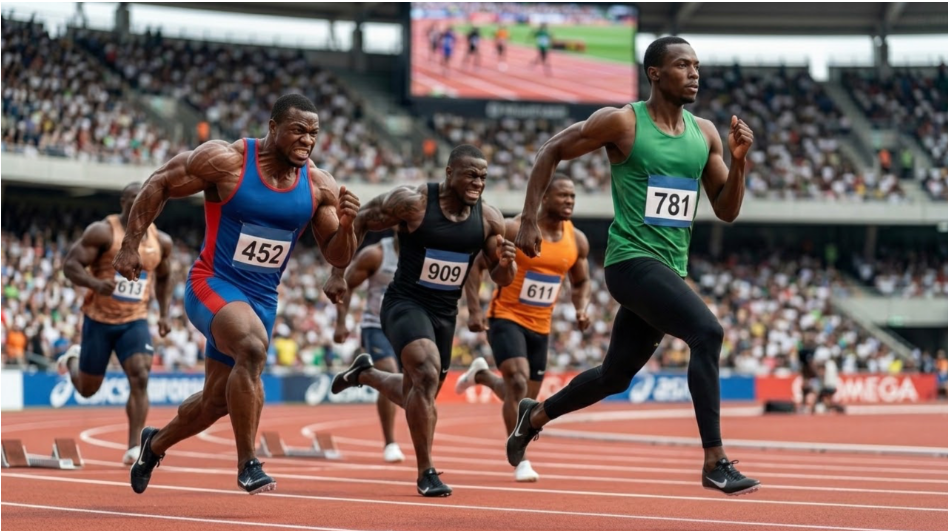
An unforgettable tale of two medicines.
This is a tale of two radically different ends of medicine, witnessed in the same day. The first medicine was practiced in the theatre of a purpose-built arena on the Las Vegas Strip, with prize money, billionaire backers and a promise to change the human body forever. It is the one everyone argued about, and the one I will spend most of this essay on, because it is the one that believes it is the future.
The second medicine I will come to at the end.
It was quiet, and it did not change the world in the way press releases mean that phrase. But it is the one I trust more - and I do not think the first can be understood until you have seen what it was trying, and failing, to be.
So begin with Las Vegas, where pharmacology wearing some of medicine's clothes was staging its first great theatre of commercial spectacle. The Enhanced Games arrived with the modest ambition of changing the future of human performance, which is always a bold thing to announce in a hotel complex.
The promise was simple, seductive and almost perfectly engineered for 2026. What if we stopped pretending elite sport was clean? What if athletes were allowed - openly, medically, commercially - to use performance-enhancing drugs? What if Homo sapiens, freed from anti-doping bureaucracy and the quaint belief that sport should not resemble a venture-backed pharmacology experiment with medals, finally showed us what the upgraded body could really do?
It is, to be fair, a fascinating question, and as a doctor and lifelong student of human performance I cannot dismiss it. The body is not sacred in the way we sometimes pretend. It is a wet, warm, self-repairing, self-deceiving animal spacecraft, running on food, sleep, hormones, fear, story, mitochondria, luck, and a few billion years of experimental code written by death.
And we have always enhanced ourselves. Shoes are enhancement. Spectacles, vaccines, coffee, surgery. Toasters and the modern tea bag especially so. A bicycle is a scandalous performance-enhancing device for the legs. Language is cognitive doping; writing is memory enhancement; AI is already becoming an exocortex with suspiciously good grammar and no mitochondria whatsoever. Medicine itself is, in some sense, the long and glorious refusal to accept the manufacturer's settings.
So the question is not should humans enhance themselves medically or otherwise. We already do. Massively. The real question is: what kind of medical enhancement, for whose benefit, with what evidence, under what governance, with what incentives - and at what human cost?
That is why the Enhanced Games are worth taking seriously. Not because they were an obvious success, but because their first outing accidentally revealed almost everything difficult, interesting, funny, dangerous and profound about the enhanced future now arriving around us.
What actually happened
The inaugural Enhanced Games took place on Sunday, 24 May 2026, at a purpose-built complex at Resorts World on the Las Vegas Strip - billed as the first major event explicitly designed to permit performance-enhancing drugs outside WADA's jurisdiction. Roughly 50 athletes competed across swimming, athletics, weightlifting and strongman events, for prizes deliberately theatrical: $250,000 for an event win, a $1 million bonus for a world record. The backers were equally on brand for an age in which civilisation sometimes appears to be run by a group chat between biotechnology, libertarianism and a very ambitious supplement aisle: Peter Thiel, Donald Trump Jr., Christian Angermayer.
The headline promise was a bonanza of shattered world records. It largely did not materialise. CEO Maximilian Martin declared, "We have changed the world tonight" - a brave sentence to utter after an event that, by its own preferred metric, mostly showed that the world is harder to change than a press release.
The single major breakthrough came in the pool. Greek swimmer Kristian Gkolomeev swam the 50m freestyle in 20.81 seconds, undercutting the official world record by 0.07 and claiming the million. That is genuinely fast. It is also genuinely complicated: he was competing in a framework that allowed WADA-banned substances, and wearing a banned polyurethane suit - the sort swimming already learned to fear after the super-suit era made the record books look as though someone had spilled rocket fuel into the pool. There were immediate online arguments about whether the wall touch quite matched the flashed-up time. Enhanced dismissed the claims as "completely unfounded internet drivel," citing its ISO-certified timing provider.
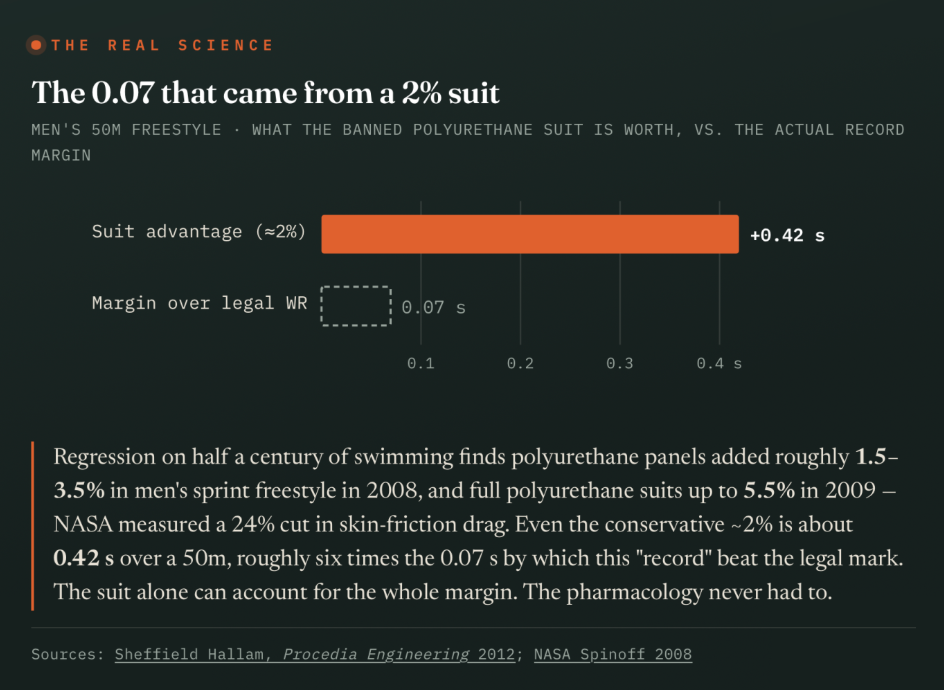
The only world record that was beaten was because of something that one might wear at niche, underground social meets.
Perhaps they are right. But that is the problem. For an event whose whole differentiator is supposed to be radical transparency and measurable performance, the only record-like success becoming the subject of online forensic debate is not a footnote - it is a structural wound. If your business is rigour, Instagram sleuths should not be part of the peer-review process.
The track was more obviously disappointing. Fred Kerley, who had predicted that Usain Bolt's 9.58 would get "destroyed," ran 9.97 in the 100m. That is not destroying Bolt. That is mildly irritating his ghost. For context, Kerley ran 9.81 for bronze at the Paris Olympics; a 9.97 would have placed him last in that final. The race was interrupted repeatedly by false starts and, in an almost too-symbolic detail, an untied shoe. If one were writing the scene too obviously, an editor would ask you to remove the shoe. Kerley claimed he competed without enhancers and still collected $250,000.
Which brings us to the detail that quietly undercuts the entire thesis: multiple athletes who said they were drug-free went on to win events. Barbadian sprinter Tristan Evelyn won the women's 100m in 11.25 and said, "This proves that winning takes more than chemistry" - a sentence that may deserve its own commemorative plaque. In the strongman event, Hafthor Bjornsson beat Mitchell Hooper in a deadlift showdown, locking out 475kg, while both failed on historic 515kg attempts. British swimmer Ben Proud, openly enhanced, won the 50m butterfly in 22.32 - 0.05 outside the world record - and called it "frustrating." That may be the most human word in the entire story. Not transcendent. Not epoch-defining. Frustrating.
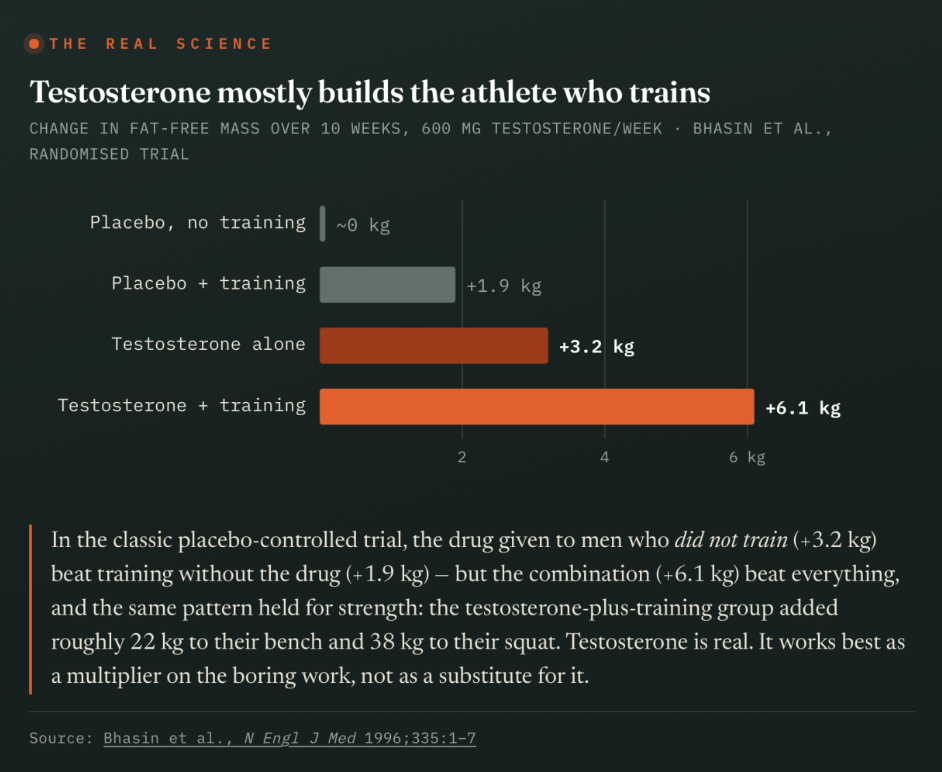
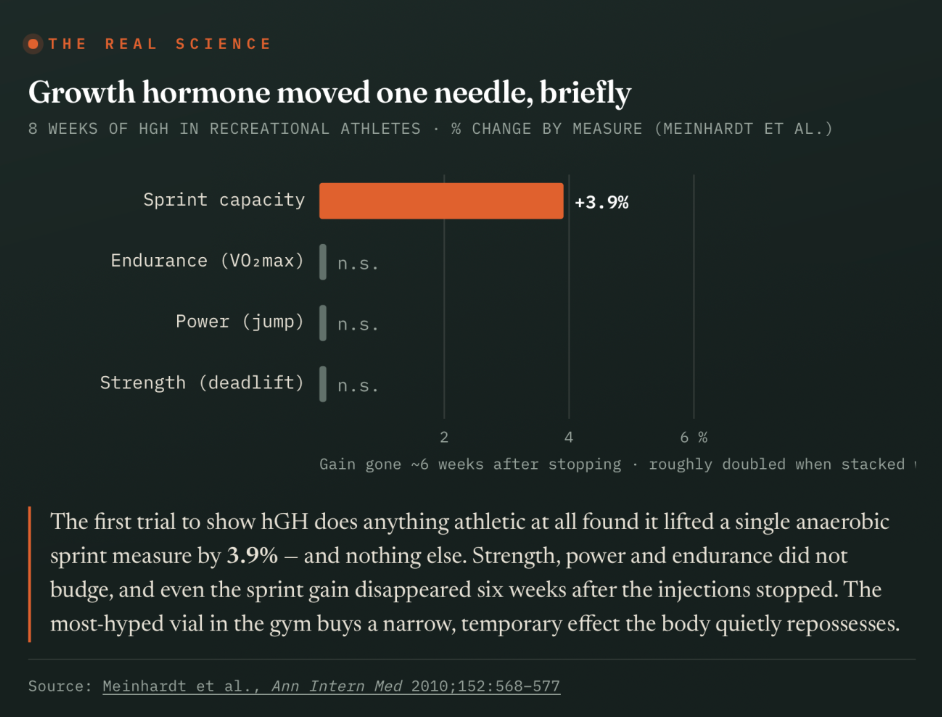
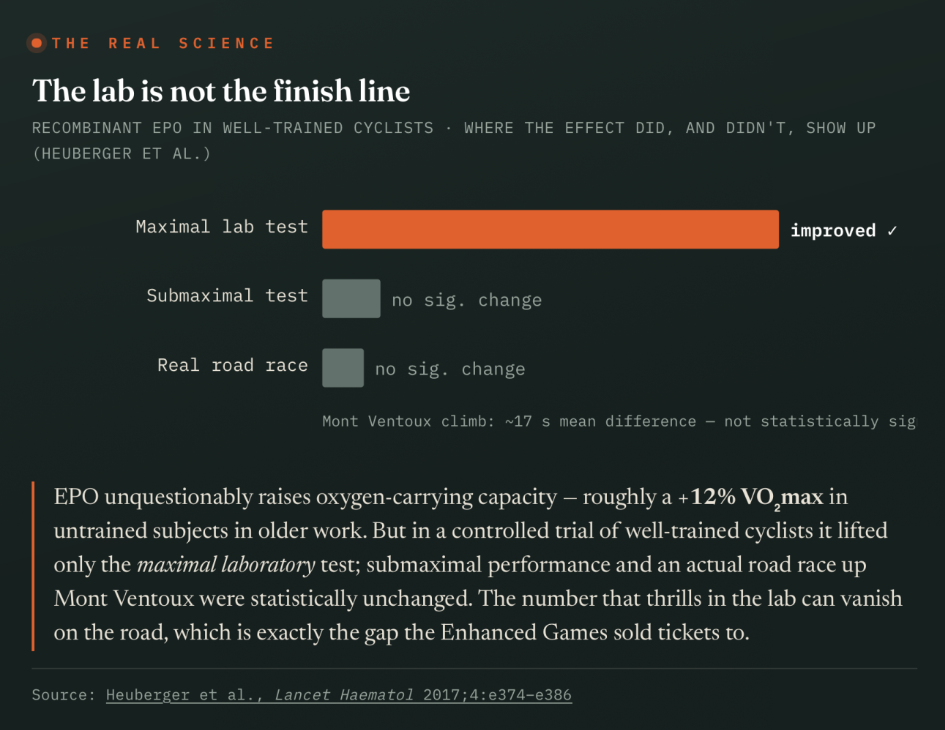
On the disclosure itself, organisers published a breakdown over an eight-week preparation window: among those who doped, 91% used testosterone or testosterone esters; 79% human growth hormone; 62% stimulants such as Adderall; 41% EPO. The event did not lack pharmacological ambition. It lacked the promised biological fireworks. This does not prove enhancement is useless. It proves enhancement is not magic.
The commentary — pro and anti
The pro-Games case is more interesting than many critics want to admit, and the most intellectually honest defence did not come from the organisers. It came from the argument buried underneath the spectacle. Associate Professor Kagan Ducker of Curtin University noted that the Games are a unique opportunity to see how illegal methods and substances actually affect performance - precisely because they are normally banned, which suppresses both research interest and research viability.
That is a serious point. There is a genuine evidence vacuum here, not because these substances are not used - they have been, for decades - but because elite sport has been shadowed by underground human experimentation: secretive, partial, denied, badly documented, and scientifically contaminated by everyone's incentive to lie. That is a terrible way to generate truth. A transparent, medically monitored cohort could, in principle, tell us something real about training adaptation, cardiovascular structure, mood, tendon injury, fertility and what arrives years later wearing the bland expression of a lab result. Enhanced has leaned into this, pointing to an IRB-approved study, ASCEND001, with a five-year observational period now commencing. That - the data, the long follow-up - is the defensible part. Not the smoke. Not the stage.
There is also a philosophical argument, and it is not stupid. The Games position themselves at the intersection of individual performance, scientific optimism, personal freedom and the rejection of outdated institutional constraints - a sentence that is, depending on one's mood, either stirring or the mission statement of a yacht that has just become self-aware. But the underlying questions matter. Who owns the body? What risks should competent adults be allowed to take? If athletes already push themselves to extremes through training loads, weight cuts, painkillers, concussions, surgery and altitude camps, why is pharmacology the unique moral red line? These deserve serious answers.
But the anti-Games case is not merely moral panic. World Aquatics called it a "circus, built on short-cuts"; the IOC and WADA declared the results illegal; medical commentators warned of high blood pressure, abnormal cardiac growth, kidney and liver damage, muscle ruptures, addiction, psychosis, aggression and mood swings. Dr Catherine Norton of the University of Limerick flagged the specific danger of layering multiple substances at doses beyond therapeutic recommendations, in a model where the pressure to push boundaries is built into the business.
That is the crucial point. The ethical problem is not that the Games are unnatural - that argument is far too weak. Nature produces smallpox, cholera and the charming tendency of coronary arteries to turn breakfast into a narrowing. Natural is not a synonym for wise; artificial is not a synonym for dangerous. The problem is structural. Large prizes offered to athletes - many without the financial security enjoyed by the people funding the event - make "informed consent" do a heroic amount of ethical load-bearing. Consent is necessary. It is not always sufficient. A person can understand a risk and still be unfairly pressured by circumstance. Poverty can sign forms. Ambition can sign forms. The hunger for one more chance can sign forms.
Even Ducker, who sees scientific value in the phenomenon, landed one of the sharpest blows: paying lower-income athletes to participate in risky enhancement research can look uncomfortably like luring vulnerable groups into danger for money. That critique is hard to dismiss.
The second structural problem is escalation. A business model built on records does not merely invite participation; it invites pushing - more, higher, stacked, optimised. The athlete who takes one compound becomes less interesting than the one who takes three, and the $1 million record bonus becomes a gravitational field. Soon "medically supervised" risks becoming a phrase doing the work of a priest at a casino wedding. It sounds reassuring; it may not be enough. Doctors can monitor harm. They cannot abolish incentive design. A consent form is not a forcefield, and a blood test is not a moral philosophy. The body keeps score even when the market has moved on - the heart remodels, the kidneys endure, the tendons complain - and the future usually arrives not in one dramatic flash of genius but as a bill.
The verdict the market delivered
This is where it gets brutal, and it matters for anyone interested in the commercial machinery now forming around health, longevity and performance. The Enhanced Games are not only a sporting provocation; they are a marketing funnel for a listed company, Enhanced Group, whose wider business sits in the peptide, supplement and biohacking market. The event was not just a question. It was meant to be a demonstration - to convert controversy into attention, attention into credibility, credibility into market value, and market value into the next phase of an enhanced commercial future.
And it did generate signal. The company announced more than $32 million in aggregate sponsorship value, including brands such as ZOOP, Rumble and Roku, and said viewership exceeded internal expectations. A drug-permissive Olympics in Las Vegas was always going to attract attention; it is almost perfectly engineered for the algorithmic glandular system of modern media. Controversy, moral outrage, libertarian glamour, tech money, athletes, doctors, a pool, a stage, and the faint smell of a pitch deck being converted into destiny.
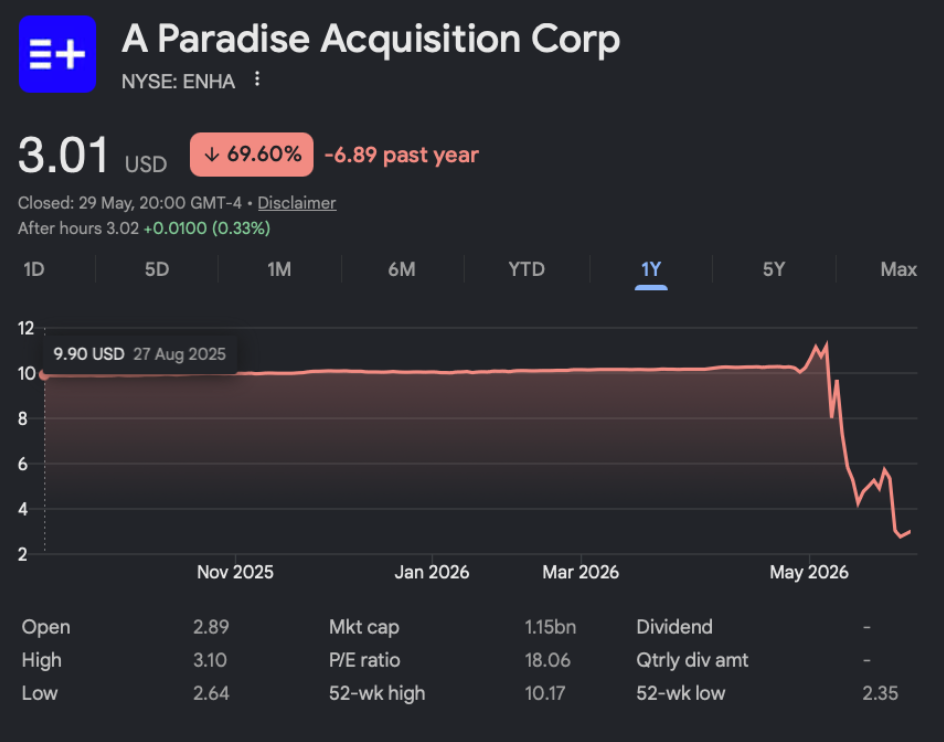
But attention is not proof, and controversy is not durability. A company can win the news cycle and lose the thesis. Investors understood this quickly. After a debut marred by technical problems, underwhelming performances and questions over its one record-like result, the stock collapsed - from the mid-teens to roughly $2.57 within days, a fall of more than 40% in a single session to an all-time low, dragging a company once valued at $1.2 billion down toward a market cap under $400 million.
The reaction matters because it was not the verdict of moralists. It was people asking a colder question: did the spectacle prove the business? And the answer appeared to be - not enough. One record-equivalent swim, aided by a banned suit and contested by online observers, does not validate a billion-dollar story. A disappointing sprint does not validate the superhuman thesis. Clean athletes winning does not validate the inevitability of pharmacological superiority. A show can be culturally noisy and commercially weak; a funnel can work for attention and fail on proof. For anyone building in longevity, performance medicine or AI-enabled care, this is a magnificent warning. In health especially, biology eventually asks for receipts.
Critique — the deep read
Stripping away the noise, here is what the inaugural Games actually demonstrated, and where the model is genuinely flawed versus genuinely interesting.
1. The central thesis was empirically weakened by its own event. The implicit premise was that pharmacological freedom unlocks superhuman performance. The event produced a more modest and inconvenient result: drug-free athletes won multiple events, the marquee sprint was nowhere near Bolt, and the one great moment came by a hair, in a banned suit, under conditions official sport will not recognise. The Games inadvertently ran a natural experiment and produced a null-to-modest result for acute, headline-grabbing enhancement - which is, ironically, what physiology might predict. These compounds mostly help athletes train harder, recover faster, build lean mass and tolerate load. They do not add a clean, cinematic 2% to an already elite, genetically selected human on the night. The real work happens in the boring places - recovery, training load, tissue repair, haemoglobin, the ability to come back tomorrow and do the difficult thing again. Enhancement helps build the athlete. It does not produce an instant god on race night. The Games conflated two claims: that pharmacology can alter training and adaptation (true), and that it will turn elite athletes into record-destroying superhumans on demand (far less true). The first belongs in science. The second belongs in a trailer.
2. The genuinely valuable idea is buried under the spectacle. Ducker is right about the evidence vacuum, and a transparent, longitudinal cohort is the most defensible part of this project - arguably the only part with lasting scientific value. The tragedy is that the Vegas wrapper actively undermines the credibility the research arm needs. You cannot easily be a serious clinical-evidence generator and a circus built on short-cuts at once. Clinical research requires sobriety, uncertainty and stopping rules; entertainment requires escalation, confidence and the next bigger thing. Research asks what happened, to whom, at what cost, against what baseline, over what period, with what uncertainty. Spectacle asks whether the record fell. Those are different epistemologies - one belongs in medicine, the other in a casino.
3. The ethics problem is structural, not incidental. The socio-economic coercion critique is the hardest to dismiss. When compensation preferentially attracts athletes with limited income into a high-risk intervention, informed consent may not be strong enough to carry the weight placed on it - and when the model includes large record bonuses, the incentive is not merely to participate but to exceed, to become the person willing to go further. That is precisely the dynamic that turns "medically supervised" into a fig leaf over time. Not because the doctors are bad, the athletes foolish, or the founders cartoon villains in expensive shoes - but because incentives have gravity, and systems produce behaviour. Once the system rewards boundary-pushing, someone eventually pushes harder than the system expected. That is how many human disasters begin: not with evil, but with optimism, incentives and insufficiently imaginative governance. Icarus was not wrong because he wanted to fly. He was wrong because he confused a technological breakthrough with freedom from consequence. The wings worked - until they didn't.
4. Governance and data verification are the soft underbelly. The disputed timing around the one major performance is devastating not because the online critics are necessarily right, but because the Games' entire pitch is transparency and measurement. If your differentiator is rigour, the verification layer has to be beyond reproach. For any venture in human optimisation, the lesson is the same: enhancement narratives live or die on measurement infrastructure - baseline clarity, independent oversight, longitudinal follow-up, adverse-event reporting, audit trails, stopping rules - not on branding, vibes or charismatic unicorn founders. The boring architecture is the product. The unglamorous infrastructure is what makes the glamour safe enough to exist. This is equally true across the wider field - peptides, hormones, exosomes, rapamycin, NAD, GLP-1s, gene editing, epigenetic clocks, supplements with names that sound like Greek gods or discontinued fax machines. Some of it will become medicine. Some will be theatre in a lab coat. The job is to know which is which before too many people pay for the wrong thing with their money, their hope or their biology. That requires measurement, not mood.
5. The market read may be the most honest critique of all. Investors were not asking whether anti-doping law is philosophically coherent. They were asking whether the event validated the commercial thesis - and the answer was, at best, not yet. The funnel worked for attention. It failed on proof. If your business depends on demonstrating that enhancement creates visible, dramatic, monetisable superiority, the first public demonstration cannot look like a modest swim, a disappointing sprint, some clean winners and a great deal of explanation. The market is often foolish. But sometimes it is an expensive sarcasm machine, and here it seemed to say: nice trailer; where is the film?
What a grown-up enhanced future would require
The Enhanced Games matter because they are a mirror held up to the entire human optimisation industry, where the same temptations are everywhere. Promise the future. Sell agency. Borrow the language of medicine, the glamour of science, the urgency of mortality, the status anxiety of the successful, the deep human longing not to lose oneself cell by cell. Then package it as enhancement. This does not mean the field is fraudulent. It means the field is important enough to be dangerous.
We are moving from a medical culture that treats disease after it appears to one that increasingly wants to optimise probability before disease is definite. That is a profound shift - perhaps one of the central ones of this century. But prevention and enhancement are not automatically the same thing. Healthspan and spectacle are not the same thing. A better biomarker is not always a better life; a higher output is not always a wiser organism; a faster sprint is not necessarily a more admirable civilisation. The body is not a Formula 1 car with feelings. We are stranger than that - galaxies of cells pretending to be a person for a few decades, temporary arrangements of atoms that have learned to ask whether the arrangement might be improved.
A serious enhanced future might begin by separating roles that the Games deliberately fused. I am not 100% aligned here as I do not believe in a world where humans do not have the freedom to make mistakes. And indeed many of our greatest medical breakthroughs that have enhanced the lives of billions have from self-consenting experimentation. But, in general the purists are right: Research is not entertainment. Medicine is not marketing. Consent is not theatre. Athletes are not disposable proof-of-concept organisms who have signed-away the right to life-long follow up. Data is not a brand asset unless the governance around it deserves trust. It would require oversight at very least sitting top table to the spectacle, if not at the head of it; transparent protocols, backed by independent lab findings, and open adverse-event reporting, with a long, long follow up; a recognition that $1m prize for the odd natural world record broken is not a scratch on the millions someone has to foot the bill for for popped arteries or bust kidneys or whatever the consequences might be; honest baselines that ask not merely "did someone break a record?" but what changed relative to this person's own prior physiology, their training history, their expected trajectory - and at what cost, and what happened afterwards. It would require medical selection: not whether a compound is legal or available, but whether this person, with this heart, this blood pressure, this psychiatric and family history, this kidney and this life, should be exposed to this, that or the other. It would require a consent process that tests comprehension rather than collecting signatures, insurance that survives the press release, and ethics designed for real humans rather than rational economic cartoons who live nowhere, owe nothing and never need money.
That would build a model for seeing if we can enhance ourselves to stay in game, as super-veterans. That would be worth building. That would be worth studying. That might even be worth watching. With a protein enhanced vegan hotdog.
And it would require remembering that humans do not just take molecules. We make meanings. Call something cheating and it becomes shame; call it freedom and it becomes rebellion; call it science and it borrows authority; call it medicine and it borrows trust; call it longevity and it borrows the fear of death; call it optimisation and it borrows the modern terror of being insufficient. The words are part of the pharmacology.
The Other Medicine.
This is the Medicine I know and love. Even as an extreme environments physiology fanatic for decades and 10,000+ proper V02 Max tests under my lab’s belt, I love this Medicine more than the first one. It is the one that, when it does what it’s supposed to do, gives me goosebumps. And zero roid-acne.
I said I had held something back. The day of the first Enhanced Games was also the day my best friend died of cholangiocarcinoma, a cancer that normally kills you in a couple of years, that came back as pancreatic recurrence. That is the other medicine, and it is the one I truly admire.
What I watched in his final months, weeks and days was not survival as slogan, not the cheap fluorescent language of "beating cancer," which can make the dying feel as though they have failed an inspirational seminar. It was human endeavour and survivorship in the deeper sense: time gained, pain relieved, uncertainty managed. The long, unglamorous, astonishing work of medicine doing what it does at its best - not defeating nature and death, because death remains stubbornly well backed by entropy and other annoying laws of physics, but creating more time for love to happen before biology closes the argument.
And then, at the end, when cure was no longer the offer, medicine performed its final act. Not victory. Not miracle. The quiet art of helping a human being die without being reduced to suffering - spectacular precisely because it was quiet. Honed. Humane. A human being held by remarkable liver transplant miracles, skill, love, science, drugs, compassion, judgement, evidence, family and care until medicine could no longer hold back death, and then medicine changed task: from prolonging life to protecting dignity, from fighting disease to relieving suffering, from more to enough.
This is an enhancement of another type of game. The game, often times unfairly, that nature plays and we, as doctors, clinicians, nurses, carers and biomedical scientists fight hard to win against. That is the version of enhancement I respect. Not enhancement as domination. Not as a way of trying to clip a few milliseconds of a 100m time. Enhancement as adding quality of lift and quality of time - helping a person remain more fully themselves for as long as they need.
In a great many ways, be it for prevention, or therapy, or being able to walk up the stairs with COPD or ski with one leg, medicine is an enhancement game, but not in the way of the Enhanced Games.
Meanwhile, in Las Vegas, medical performance enhancement was taken to a sickening extreme sold as spectacle, for financial gain: a promise that the body could be made more thrilling, more monetisable, more record-breaking, more investor-friendly. Just oddly not in the same way that I respect the discipline of the elite body-builder or UFC athlete. It was different. It was a punch in the face of regular sport, though that too has done a lot of harm to humans pushing them to psychological extremes. But, as expected in the Enhanced Games the body did what the body so often does. It complicated the story. It refused to become a pitch deck. It gave them one swim, some caveats, a disappointing sprint, a few clean winners and a lesson in humility. It they take it. Angermeyer will likely not. But that’s mushroom-trip optimism’s greatest trick.
That does not make the Enhanced Games worthless - it may make them useful if work is done. The enhanced future is coming; it is already here in fragments, in intensive care and fertility clinics, in prosthetics and vaccines, in AI-supported diagnosis and GLP-1 off label use and longevity labs, in the quiet daily lives of millions who would rather not accept the decline that nature, with its usual indifference, has pencilled in. The question is not whether we enhance. It is whether enhancement grows up - whether it becomes science, medicine and wisdom, or remains a casino with better hormone patches.
The first outing taught a lesson almost opposite to the one the spectacle intended. Not that drugs make gods, but that biology is more stubborn, more comic, more elegant and more humbling (potentially) than the IPO’s pitch deck. Mammalian life, sapiens in particular, is simply not an inspiring TED talk with mitochondria. It is a negotiation with deep time, an argument between entropy and local-minima complexity, of damage and repair, of self vs non-self, of the inside and outside worlds, a temporary truce among 38 trillion competing cells, most of whom did not attend the investor meeting. And it can be improved - beautifully, powerfully, sometimes radically. But not elegantly by confusing spectacle with evidence, not wisely by confusing consent with justice, not durably by confusing attention with proof.
I am in favour of the future. Perhaps the line someone might chisel into my headstone would be something on the lines of “was always in the future, ever annoyed with now, and now definitely in the past”. I am more than in favour of studying humans in extremes and enhancement of our lives, especially our performance in later life, and asking what humans can become without losing their sense of humour. But I am not in favour of pretending that every commercial provocation is a scientific revolution, or that every risk becomes ethical because someone signed a form next to a prize purse. Several friends and colleagues in my profession who doped athletes for these games, I will continue to riff with on this just the same. And encourage them to their duty of care for follow up for the next 30 years for their patients. A properly medically enhanced future or perhaps better our enhanced medical future deserves better than spectacle for peptide manufacturer stock prices to go up. It deserves seriousness, awe, measurement and open-minded scrutiny. Therein it might hold the key to us still skiing when we’re 90. And who would not want that?
And it deserves to remember that the greatest medicine I saw that day was not in Las Vegas at all, but in Thousand Oaks, just up from LA. At my best friend’s home. Where he could look out at his lovely Eucalyptus tree from his bedroom window. And spend his final time holding the hands of his young son and amazing wife. It was quiet. It was loving. This medicine did not break any world records, and it did not need to. It helped a human being remain human for eight more years, right up to the very edge of life - and that, in the end, may be the most enhanced thing medicine ever does.
References & sources
THE SCIENCE
Bhasin S, Storer TW, Berman N, et al. The effects of supraphysiologic doses of testosterone on muscle size and strength in normal men. N Engl J Med. 1996;335(1):1–7. PubMed
Heuberger JAAC, Rotmans JI, Gal P, et al. Effects of erythropoietin on cycling performance of well trained cyclists: a double-blind, randomised, placebo-controlled trial. Lancet Haematol. 2017;4(8):e374–e386. Lancet Haematology
Meinhardt U, Nelson AE, Hansen JL, et al. The effects of growth hormone on body composition and physical performance in recreational athletes: a randomized trial. Ann Intern Med.2010;152(9):568–577. Annals of Internal Medicine
Influence of full body swimsuits on competitive performance. Procedia Engineering(Engineering of Sport 9), 2012 — Sheffield Hallam University. ScienceDirect
Space Age Swimsuit Reduces Drag, Breaks Records. NASA Spinoff 2008 (LZR Racer skin-friction drag reduced ~24%). NASA
THE EVENT
Farrant T. Inside the Enhanced Games: everything that happened on sport's most controversial night. Euronews, 26 May 2026. euronews.com
Greek swimmer cashes in with 'world record' at Enhanced Games. Reuters, 25 May 2026.
Enhanced Games owner (ENHA) sinks as debut event hit by myriad of issues. Bloomberg, 26 May 2026.
Note: world-record figures, drug-use percentages and effect sizes are reported as published; results set at the Enhanced Games are not recognised by World Aquatics, World Athletics, the IOC or WADA. Effect-size charts illustrate findings from the cited trials and are not predictions of any individual athlete's result.