
The Focus Drug: A Clear-Eyed Analysis
Genuine focus, but genuine dependence.

The quiet habit in the high performance workplace
Nicotine pouches have quietly become part of the work performance toolkit. A pouch tucked under the lip through a board meeting, a window of focussed work, a fundraise, a late project. No smoke, no smell, no plume, and a clean hit of focus. Among people who would never have previously touched a cigarette, these little tins now sit next to the laptop.
The pitch is seductive: all of the edge, almost none of the harm. Swedish snus, the tobacco product these pouches descend from, is genuinely far less harmful than smoking. That part is true and worth saying up front.
But "far less harmful than smoking" is doing a lot of work in that sentence, and for a healthy individual who has never smoked it may be the wrong comparison entirely.
This piece is not going to be the advice to start or stop. It is simply a straight account of the trade you are actually making, so you can decide for yourself. If you do use these products, the dose and your own risk profile belong in a conversation with your doctor.
What a pouch actually does for focus
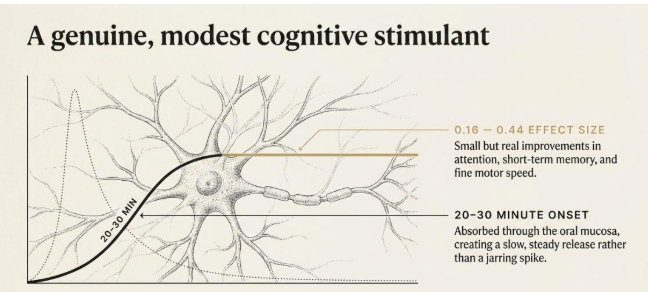
Nicotine is a genuine, if modest, cognitive stimulant. A meta-analysis of 41 placebo-controlled studies found small but real improvements in attention, short-term memory and fine motor speed, with effect sizes between roughly 0.16 and 0.44, and these held up in people who were not in withdrawal [1]. So the lift is real, not just the relief of a craving.
Modest is the operative word. These are small effects, on narrow tasks, not a transformation of how well you think.
A pouch delivers that nicotine slowly. Absorbed through the lining of the mouth over twenty to thirty minutes, it rises more gradually than the spike from a cigarette but reaches similar levels in the blood over time [2]. The slow, steady release is exactly what makes it easy to use across a working day, and exactly what trains the brain to expect it.
That is the part the conversation around focus leaves out. The same receptor changes that produce the lift are what build dependence, and the dependence snus and pouches produce is closely comparable to cigarettes on the measures that matter.
The harm-reduction truth worth hearing
Here is the case in favour of snus. Sweden ran the experiment for us. As snus use rose, male daily smoking fell from 40% in 1976 to 15% by 2002, faster than anywhere else in Europe, and around a third of male ex-smokers used snus to quit [3]. In a matched comparison, 66% of men who used snus to stop smoking succeeded, against 47% for nicotine gum and 32% for the patch [4].
Regulators have caught up with this. In 2024 the US FDA renewed its authorisation for General Snus to be sold with the claim that using it instead of cigarettes lowers the risk of mouth cancer, heart disease, lung cancer, stroke, emphysema and chronic bronchitis [5]. That is a real, evidence-backed reduction in harm relative to smoking.
So if you smoke, switching completely to snus or a pouch is a genuine step down in risk. Nothing that follows contradicts that.
The trap: "safer than smoking" is the wrong comparison
The trap is in the comparator. "Safer than cigarettes" only helps you if cigarettes are your alternative. If you have never smoked, your alternative is not smoking, it is nothing, and against nothing the picture changes.
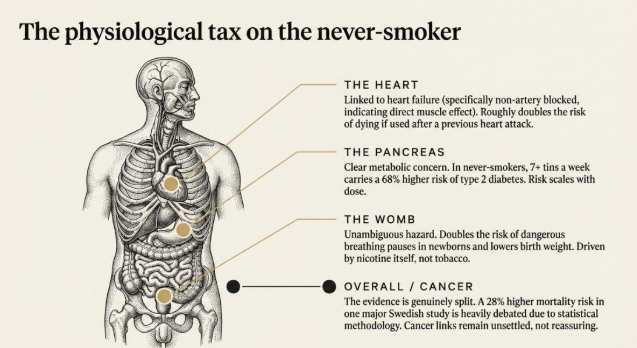
Start with the hardest-fought question: overall mortality. A pooled analysis of 169,103 never-smoking Swedish men found exclusive snus users had about a 28% higher risk of death from any cause, and a similar rise in death from cardiovascular causes [6]. That sounds settled until you notice the same research group's earlier work found no such link for individual diseases, and a published critique argues the pooled mortality finding rests on unresolved statistical problems [7]. The fair position: a modest excess risk is plausible, not proven.
Underneath that debate, a few signals are more coherent. Snus is linked to heart failure, specifically the kind not caused by blocked arteries, which points to a direct effect on the heart muscle rather than one driven by a heart attack [8]. Heavy use is the clearest metabolic concern: in never-smokers, seven or more tins a week carried a 68% higher risk of type 2 diabetes, with risk climbing steadily for each additional tin [9]. And for anyone who has already had a heart attack, continuing to use snus roughly doubles the risk of dying compared with stopping, a benefit from quitting the same size as giving up cigarettes [10].
The cancer evidence is genuinely split. Large Swedish pooled studies found no association with oral or pancreatic cancer, with hazard ratios of 0.90 and 0.96 [11][12]. A more recent independent review found a possible increase in cancer of the oesophagus, stomach, pancreas and rectum in exclusive users, though its confidence in those estimates ranged from moderate down to very low [13]. Unsettled, not reassuring.
One line is not split at all. Snus should not be used in pregnancy. The best review found it probably about doubles the risk of dangerous pauses in a newborn's breathing, and possibly raises stillbirth, very premature birth and cleft malformations, while cutting birth weight by around 70 grams [14]. The cause is the nicotine itself, so a tobacco-free pouch offers no protection here.
The local effects are milder and mostly reversible. Regular use causes gum recession and irritation where the pouch sits, although the evidence does not link snus to the destructive gum disease that smoking causes [15].
The product you are actually using
Most people reaching for a pouch today are not using Swedish snus at all. They are using a tobacco-free pouch such as Zyn, which holds nicotine in a fibre pad with no tobacco leaf. In how it delivers nicotine, it behaves much like snus, releasing it about as quickly and to a similar degree [16].
Removing the tobacco leaf removes the tobacco-specific carcinogens that drive most of snus's residual cancer risk, which is a real advantage. But "fewer toxic chemicals" is not the same as "proven safe", and there is no long-term outcome data on these products at all. The American Heart Association's 2024 statement is blunt: oral nicotine pouches are addictive, and no data exist on their cardiovascular or wider health risks [17].
A regulatory quirk is worth knowing too. Snus itself is banned across the EU and in the UK, with a special exemption only for Sweden [18]. Tobacco-free pouches fall outside that ban, which is why they, and not snus, are what you can actually buy here. The legal status reflects how the rules were written, not a verdict on relative safety.
So how should you decide?
Strip it back to your own situation.
If you smoke, switching fully to snus or a pouch is a defensible harm-reduction move with good evidence behind it. Switch completely rather than running both, and treat it as a step on the way down, not a destination.
If you have never smoked, the sensible clinical default is not to start. You would be taking on a real dependence and a set of non-trivial, partly unresolved risks to buy a small, short-lived bump in focus you can get more reliably from sleep, training and how you structure your day.
If you already use pouches and intend to continue, three concrete steps for this week. Cap your volume well below the diabetes threshold: keep it under five tins a week. Never use them in pregnancy or while trying to conceive, and stop entirely if you have had a heart attack. And set a review date ninety days out to decide whether you are still choosing this or just feeding it.
The focus is real. So is the bill. Decide with both in view.
Q&A
Are nicotine pouches safe because they do not contain tobacco?
No. Tobacco-free pouches remove the tobacco-specific carcinogens, which lowers cancer risk relative to snus, but they still deliver an addictive dose of nicotine and have no long-term safety data [16][17]. "Fewer harmful chemicals than tobacco" is not the same as "safe".
Is snus better than vaping for quitting smoking?
Both are far less harmful than cigarettes, and both can help smokers quit. There are no head-to-head trials directly comparing them for cessation, so anyone claiming one is clearly superior is going beyond what the evidence supports.
Does nicotine actually make you sharper?
Modestly and briefly. Controlled studies show small genuine gains in attention and memory [1], but the effects are narrow and come bound to dependence. It is a real but minor stimulant, not a cognitive edge worth acquiring a habit for.
What is the single clearest reason to avoid them?
Pregnancy. The evidence that snus harms the developing baby is among the most consistent in the field, and because the cause is nicotine itself, tobacco-free pouches carry the same risk [14].
If I only use a couple of tins a week, am I in the clear?
Lower volume lowers some risks, notably diabetes, which is strongly dose-related [9]. But it does not remove dependence, and the mortality and pregnancy questions are not about volume. Less is better; none is cleanest.
Further Reading
[1] S. J. Heishman, B. A. Kleykamp, and E. G. Singleton, 'Meta-analysis of the acute effects of nicotine and smoking on human performance', Psychopharmacology (Berl.), vol. 210, no. 4, pp. 453-469, Apr. 2010, doi: 10.1007/s00213-010-1848-1.
[2] H. Digard, C. Proctor, A. Kulasekaran, U. Malmqvist, and A. Richter, 'Determination of nicotine absorption from multiple tobacco products and nicotine gum', Nicotine Tob. Res., vol. 15, no. 1, pp. 255-261, Jan. 2013, doi: 10.1093/ntr/nts123.
[3] J. Foulds, L. Ramstrom, M. Burke, and K. Fagerstrom, 'Effect of smokeless tobacco (snus) on smoking and public health in Sweden', Tob. Control, vol. 12, no. 4, pp. 349-359, Dec. 2003, doi: 10.1136/tc.12.4.349.
[4] L. M. Ramstrom and J. Foulds, 'Role of snus in initiation and cessation of tobacco smoking in Sweden', Tob. Control, vol. 15, no. 3, pp. 210-214, Jun. 2006, doi: 10.1136/tc.2005.014969.
[5] U.S. Food and Drug Administration, 'FDA renews authorization for 8 General Snus products to be marketed with reduced risk claim', Nov. 2024. [Online]. Available: https://www.fda.gov/tobacco-products/fda-renews-authorization-8-general-snus-products-be-marketed-reduced-risk-claim
[6] M. L. Byhamre, M. Araghi, L. Alfredsson, R. Bellocco, G. Engstrom, M. Eriksson, et al., 'Swedish snus use is associated with mortality: a pooled analysis of eight prospective studies', Int. J. Epidemiol., vol. 49, no. 6, pp. 2041-2050, Dec. 2020, doi: 10.1093/ije/dyaa197.
[7] B. Rodu and N. Plurphanswat, 'Heterogeneity and other problems in a pooled analysis of snus use and mortality', F1000Research, vol. 10, p. 388, May 2021, doi: 10.12688/f1000research.52127.1.
[8] M. Araghi, M. R. Galanti, M. Lundberg, Z. Liu, W. Ye, A. Lager, et al., 'No association between moist oral snuff (snus) use and oral cancer: pooled analysis of nine prospective observational studies', Scand. J. Public Health, vol. 49, no. 8, pp. 833-840, Nov. 2021, doi: 10.1177/1403494820919572.
[9] S. Carlsson, T. Andersson, M. Araghi, R. Galanti, A. Lager, M. Lundberg, et al., 'Smokeless tobacco (snus) is associated with an increased risk of type 2 diabetes: results from five pooled cohorts', J. Intern. Med., vol. 281, no. 4, pp. 398-406, Apr. 2017, doi: 10.1111/joim.12592.
[10] G. Arefalk, K. Hambraeus, L. Lind, K. Michaelsson, B. Lindahl, and J. Sundstrom, 'Discontinuation of smokeless tobacco and mortality risk after myocardial infarction', Circulation, vol. 130, no. 4, pp. 325-332, Jul. 2014, doi: 10.1161/CIRCULATIONAHA.113.007252.
[11] G. Arefalk, M.-P. Hergens, E. Ingelsson, J. Arnlov, K. Michaelsson, L. Lind, et al., 'Smokeless tobacco (snus) and risk of heart failure: results from two Swedish cohorts', Eur. J. Prev. Cardiol., vol. 19, no. 5, pp. 1120-1127, Oct. 2012, doi: 10.1177/1741826711420003.
[12] M. Araghi, M. Rosaria Galanti, M. Lundberg, A. Lager, G. Engstrom, L. Alfredsson, et al., 'Use of moist oral snuff (snus) and pancreatic cancer: pooled analysis of nine prospective observational studies', Int. J. Cancer, vol. 141, no. 4, pp. 687-693, Aug. 2017, doi: 10.1002/ijc.30773.
[13] H. Valen, R. Becher, G. E. Vist, J. A. Holme, I. Mdala, I.-K. O. Elvsaas, et al., 'A systematic review of cancer risk among users of smokeless tobacco (Swedish snus) exclusively, compared with no use of tobacco', Int. J. Cancer, vol. 153, no. 12, pp. 1942-1953, Dec. 2023, doi: 10.1002/ijc.34643.
[14] B. C. Brinchmann, G. E. Vist, R. Becher, T. K. Grimsrud, I.-K. O. Elvsaas, V. Underland, et al., 'Use of Swedish smokeless tobacco during pregnancy: a systematic review of pregnancy and early life health risk', Addiction, vol. 118, no. 5, pp. 789-803, May 2023, doi: 10.1111/add.16114.
[15] M. Bankvall and M. Jontell, 'Swedish smokeless tobacco and its impact on oral health: a systematic review', Acta Odontol. Scand., vol. 85, pp. 84-95, Feb. 2026, doi: 10.2340/aos.v85.45421.
[16] E. Lunell, K. Fagerstrom, J. Hughes, and R. Pendrill, 'Pharmacokinetic comparison of a novel non-tobacco-based nicotine pouch (ZYN) with conventional, tobacco-based Swedish snus and American moist snuff', Nicotine Tob. Res., vol. 22, no. 10, pp. 1757-1763, Oct. 2020, doi: 10.1093/ntr/ntaa068.
[17] C. R. Dennison Himmelfarb, N. L. Benowitz, M. D. Blank, A. Bhatnagar, P. J. Chase, E. M. Davis, et al., 'Impact of smokeless oral nicotine products on cardiovascular disease: implications for policy, prevention, and treatment: a policy statement from the American Heart Association', Circulation, vol. 151, no. 1, pp. e1-e21, Jan. 2025, doi: 10.1161/CIR.0000000000001293.
[18] European Parliament and Council, 'Directive 2014/40/EU on the manufacture, presentation and sale of tobacco and related products', Apr. 2014. [Online]. Available: https://eur-lex.europa.eu/legal-content/EN/TXT/?uri=CELEX:32014L0040
